Crypto-collateralized lending and borrowing

Ethereum security · Swiss rule of law

Borrow

Finance your new business or your lifestyle

Crypto in your vault, money in your bank account, your data in Switzerland.

Request a Loan
Lend

Secured yield, simple fiat transfers

Attractive yield secured with 150%+ highly liquid collateral and Swiss contracts.

Start Earning

How it works

From request to bank transfer

For Borrowers
  1. 1

    Create a loan request

    Choose a currency and amount, set your desired interest and duration, pick a payout method

  2. 2

    Get matched with a lender

    A lender accepts your request (instant matching on the roadmap)

  3. 3

    Sign the lending contract

    Clear terms, no fees, Swiss rule of law

  4. 4

    Reserve the collateral

    Set your preferred LTV within the bounds. Collateral stays in your self-custodial Anvil vault.

  5. 5

    Receive the funds

    Funded from a Swiss bank account to your IBAN, or on Gnosis Chain to your wallet
Request a loan
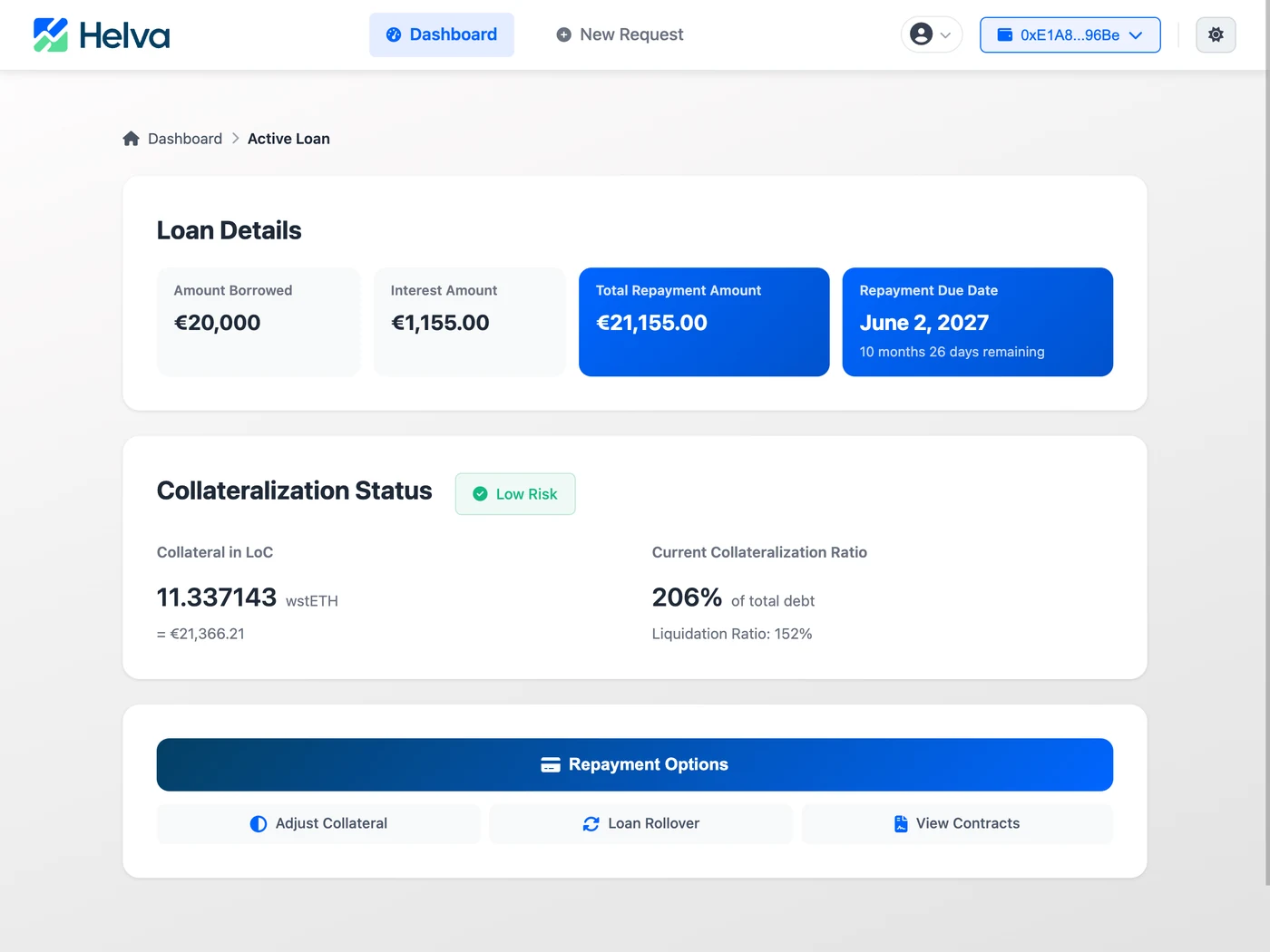
Helva borrower dashboard: an active EUR 20,000 loan backed by wstETH at a 206% collateralization ratio, marked low risk, with repayment and collateral controls.
For Lenders
  1. 1

    Find a loan request that fits

    Filter by yield, duration, or amount (smart notifications and automatic matching on the roadmap)

  2. 2

    Sign the lending contract

    Swiss-law contract plus on-chain solvency enforcement

  3. 3

    Fund the loan

    Simple IBAN transfer or a EURe deposit on Gnosis Chain

  4. 4

    Your funds earn fixed yield

    Overcollateralized and monitored 24/7 with auto-liquidation

  5. 5

    Receive principal + interest

    Receive your original deposit plus fixed interest

Start earning yield
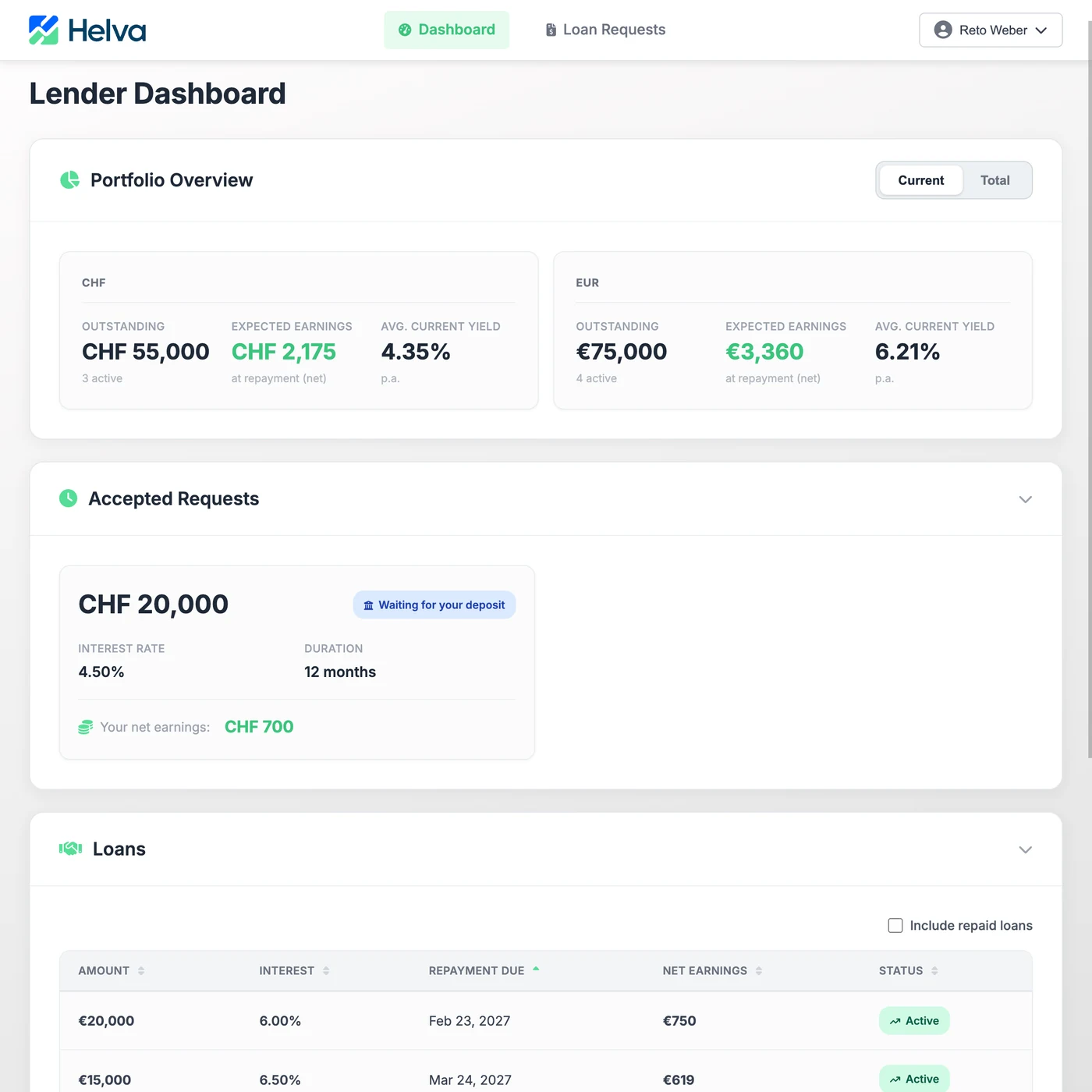
Helva lender dashboard: a multi-currency portfolio with expected earnings and average yields per currency, an accepted request, and a table of active loans.
Collateral
  • WETH
  • wstETHearns staking yield
  • WBTC
  • cbBTC
Borrow/Lend In
  • CHF
  • EUR
  • GBP
  • USD
  • EURe

Benefits

Ethereum-secured collateral. Swiss rule of law

For Borrowers

Security and privacy

  • Crypto collateral is reserved in self-custodial vaults, and only the required amount can move if necessary
  • KYC data stored in Switzerland (outside processing ephemeral), under strong Swiss privacy protections
  • For Gnosis users, the structure breaks the link between your collateral wallet and your Gnosis Pay card

Convenience and flexibility

  • Flexible collateral management — top up if prices fall, withdraw without needing permission if they rise
  • Continuous monitoring with margin calls

Simplicity and transparency

  • Funds cleared through the Swiss banking system
  • The interest rate you agree is all you pay — no origination, custody, or hidden fees

For Lenders

Security and risk control

  • Overcollateralized by highly liquid crypto-assets, with conservative liquidation thresholds
  • Solvency enforced on-chain — positions are monitored 24/7 and liquidated automatically if thresholds are breached
  • Backed by enforceable Swiss-law contracts

Predictable yield

  • Fixed interest rates
  • Loan durations from 3 to 24 months
  • Simple and attractive fee structure, charged at maturity

Simplicity and transparency

  • Funding via a Swiss IBAN or on Gnosis Chain
  • No DeFi setup, wallet tooling, or protocol interaction required
  • Repayment always in the same method as funding

Powered by

Non-custodial collateral management on Ethereum

Reviewed by industry's top security auditors

Read More

Compare

How Helva compares

For Borrowers

Fiat in your bank. Crypto in your vault.


How Helva compares to DeFi lending and Other crypto-to-fiat lending for borrowers
Attribute DeFi lending Other crypto-to-fiat lending Helva
Cash to your bank No — stablecoins From a crypto platform Yes — Vanilla transfer1
Non-custodial Yes Typically not 2 Yes — your Anvil vault
Rates Low and variable, or fixed and higher High, typically fixed n/a, fixed3
Flexibility High Varies Fixed term, rollover on the roadmap
Compliance & privacy Private on-chain, off-ramp triggers compiance Heavy onboarding Simple; Swiss data3
Collateral management Self-managed, no margin calls Varies Self-managed, with margin calls
  1. 1 Clears as a standard Swiss bank payment, decoupled from your collateral.
  2. 2 Multisig often involves centralized oracles, liquidation routes require full collateral access
  3. 3 We will provide clear comparison once the platform is live and market clears. From market research we expect competitive rates (between DeFi and crypto-banks)
  4. 4 KYC by Sumsub, followed by an immediate request to delete the data. Minimal collection; no exchange off-ramp trail. You and your lender are known to each other by contract. ZK and Swiss-based KYC on the roadmap
For Lenders

It’s not just the yield. It’s what’s behind it.


How Helva compares to savings accounts and fixed-income funds for lenders
Attribute Savings and brokerage account Fixed-income funds Helva
Yield ~0% real5 Higher Competitive, fixed
What secures it Central banks6 Often unsecured or illiquid7 Over-collateralized by liquid crypto8
Access to your money Anytime Can be gated Fixed maturity, known upfront
Rate certainty Variable — can be cut Payout can swing Fixed rate, agreed upfront
  1. 5 Real yield = nominal minus inflation;
  2. 6 Technically bank's balance sheet and deposit insurance, we're just being honest
  3. 7 Typical of the higher-yield end: corporate/private credit and real-estate funds.
  4. 8 Collateral worth more than the loan at conservative loan-to-value, auto-liquidated before it goes underwater; plus a Sihltrust first-loss reserve.

Illustrative comparison of typical alternatives, for general information only — not investment advice. Capital is at risk. Helva yields and rates are targets, not fixed promises, and any Sihltrust guarantee is limited to a first-loss reserve. Competitor characteristics are general and vary by provider.

FAQ

Frequently Asked Questions

Got a question we haven’t covered yet?
Send us a message! · contact@helva.finance

General

Which fiat currencies are supported at launch?
USD, CHF, GBP, EUR
How can collateral stay in borrower’s self-custodial vault, yet secure a loan?
The borrower reserves the collateral from their vault against a defined amount of credit asset (e.g. USDT for USD loans). This gives the lender a right to force a conversion of the necessary amount of collateral for the defined amount of credit asset under conditions defined by Anvil (if collateralization drops below the liquidation threshold) or by the platform (in case of failure to repay).
How is user privacy protected?
  • We care deeply about the privacy of our users, especially the crypto-holding borrowers. The “wrench attacks” are only accelerating due to regulators forcing more and more private data collection and storage.
  • The user profile and KYC data are stored only in Switzerland.
  • All regulatory aspects (ongoing AML processes, AML audit) are handled only in Switzerland.

Borrower

Which collateral assets are supported?
WETH, wstETH, WBTC, cbBTC
What is the maximum LTV?
The LTVs are governed by Anvil and currently stand at 56% for WETH and wstETH and 60% for WBTC and cbBTC.
What are liquidation levels?
The liquidation is governed by Anvil’s collateral factors and currently stands at 66% for WETH and wstETH and 71% for WBTC and cbBTC.
Do you issue margin calls?
Yes.
How is collateral secured?
The collateral is always held in a non-custodial smart contract-based Anvil vault and reserved against a stablecoin necessary to cover the loan. Anvil’s collateral protocol makes it possible to perform all the health monitoring and solvency enforcement functions without any private key exposure, minimizing any security risks.
What are onboarding requirements and process for borrowers?
First time borrowers must verify their email and phone number, pass an online KYC/AML check, and deposit minimum collateral for the posted loan request.
How can I repay the loan?
By original payment method (e.g. fiat or EURe) or by the collateral.
Do you also support open-ended credit?
No, but we plan to allow loan rollover by the time the first loans are maturing.
How do I top up or withdraw collateral if its price goes down or up?
You can add or reduce the collateral reservation in your vault by yourself anytime as long as the position remains sufficiently overcollateralized.

Lender

How is the loan solvency protected?
  • Every loan must be secured with collateral worth at least 150% of the lent amount
  • Only the most liquid assets are allowed as collateral.
  • Liquidation thresholds are set to safe levels.
  • Liquidation of loans breaching liquidation levels is open and incentivized, therefore pratically automatic.
If the loan gets liquidated, do I get the fiat or the collateral back?
You’ll receive the fiat as if the loan was repaid normally.
If the loan gets liquidated or repaid early, do I get the full interest or pro-rata?
You’ll receive the interest amount pro-rata, with a 3-months interest at minium.

Ready to borrow or earn yield?